
Does a Record Player Sound Better? A Practical Guide for Modern Listeners
Introduction
People argue about this question at every party where a turntable shows up: does a record player sound better than digital or streaming? Some swear vinyl is warmer and more ‘alive.’ Others say it is all nostalgia and that modern digital is technically superior. Both sides have a point, which makes the topic confusing if you just want your music to sound great.
To get clear, you need to know what ‘better’ actually means when we talk about sound. You also need to see how a record player works, how digital audio works, and where each format wins or loses in real homes, not in labs or marketing brochures.
This guide walks through the basics in plain language. You will see why vinyl can sound amazing, why it sometimes sounds worse, and how much of the difference comes from your gear, your room, and your listening habits. By the end, you will know if a record player can sound better for you, and how to set things up so you get the most from whatever format you choose.
What Does ‘Better’ Sound Actually Mean?
Before you can answer ‘does a record player sound better,’ you have to define ‘better.’ For some people, it means the sound matches the original recording as closely as possible. For others, it means the sound feels rich, smooth, and enjoyable, even if it is not perfectly accurate.
Objective Sound Quality vs Personal Preference
Engineers talk about ‘objective’ quality. They measure things like:
- Frequency response: Does the system produce bass, mids, and treble evenly?
- Distortion: Does the system add extra sounds that were not in the recording?
- Noise: How loud is the hiss, hum, or rumble compared to the music?
On paper, digital audio often wins these tests. It can have a wider dynamic range, less noise, and less distortion. But your ears and brain do not only care about numbers.
Personal preference’ is what you actually enjoy. Some people prefer a bit of warmth or softness, even if measurements say it is less accurate. Vinyl often adds small colorations that many find pleasant. That is why two people can hear the same system and disagree on which sounds better.
The Audio Basics: Detail, Dynamics, and Noise
Most listeners notice three big things when they compare sound:
- Detail – Can you hear small sounds, like fingers sliding on guitar strings or the room around a singer?
- Dynamics – Does the music feel lively, with quiet moments and big, powerful peaks?
- Noise – Is there hiss, hum, pops, or crackle that distracts from the music?
Digital audio, especially from good sources, tends to give very clean detail and low noise. A well set up record player can also give rich detail, but it usually has more noise. Some people do not mind that; they may even like a gentle background noise as part of the charm.
Why Our Ears and Brain Do Not Always Agree with Measurements
Your brain shapes how you hear. Expectation, mood, and even what you see influence sound. If you expect vinyl to sound warmer and more ‘real,’ your brain may lean into that feeling.
This does not mean the experience is fake. It means listening is more than numbers. When you drop the needle on a favorite album, flip the record, and hold the artwork, your whole body joins the experience. That often makes music feel better, even if a lab report would say it is ‘worse.
Once you understand what ‘better’ can mean, it is easier to look at how vinyl playback actually works and why it sounds the way it does.
How a Record Player Produces Sound
A record player is a mechanical system. It turns tiny bumps and wiggles in a groove into an electrical signal, which then becomes sound through your speakers. Each part of this chain affects the final result you hear in your room.
From Vinyl Groove to Electrical Signal
Music is carved into the surface of a vinyl record as a spiral groove. The groove’s side to side and up and down movements encode the sound.
When you play a record:
- The stylus (needle) sits in the groove.
- As the record spins, the stylus vibrates with the groove’s movements.
- These vibrations travel up into the cartridge.
The groove is tiny, and so are the movements. Any dust, scratch, or warp in the record also affects the stylus. That is part of why vinyl can have clicks, pops, and pitch variations if the disc or player is not in good shape.
The Role of the Cartridge, Tonearm, and Platter
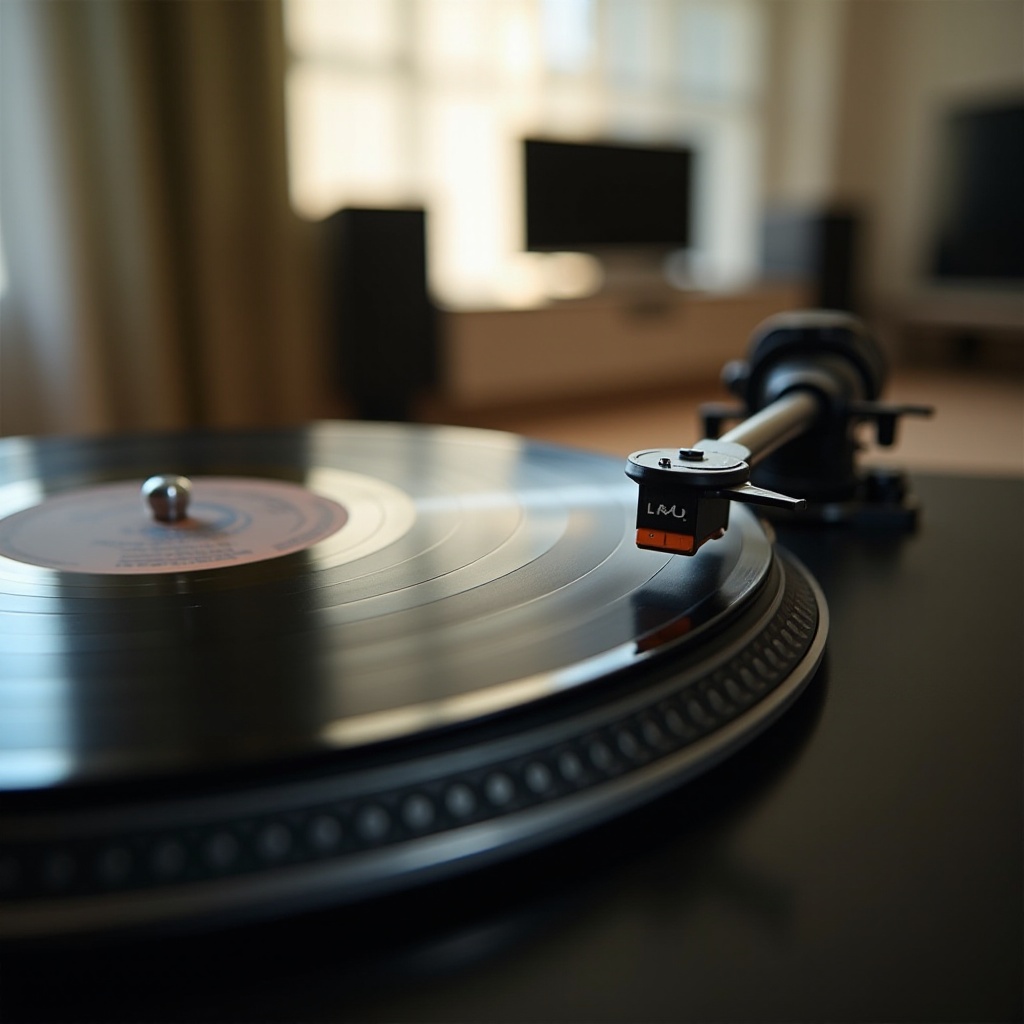
The cartridge is the small body that holds the stylus. Inside, it converts the stylus vibrations into a weak electrical signal. Different cartridge designs and stylus shapes change the sound. Some sound brighter, some warmer, some more detailed.
The tonearm holds the cartridge and lets it move smoothly across the record. Good tonearms keep the stylus stable and aligned. Poor arms can cause mistracking, distortion, and extra wear on your records.
The platter is the part that spins the record. It needs to turn at a stable, precise speed. A heavy, well damped platter helps reduce vibrations and rumble. Any speed wobble shows up as pitch instability, especially on sustained notes like piano or strings.
The Rest of the Chain: Phono Preamp, Amp, and Speakers
The signal that comes out of a cartridge is very weak and not ‘flat.’ It needs a special circuit called a phono preamp.
The phono preamp does two key things:
- Boosts the weak signal to line level.
- Applies RIAA equalization, which reverses a curve used when cutting records.
From there, the signal goes to your amplifier and then to your speakers. Each piece changes the final sound. A solid turntable can sound dull or harsh if the speakers are poor, and an average deck can sound surprisingly good with well matched speakers.
Once you see how a record player makes sound, the next step is to understand how digital and streaming systems work, so you can compare them fairly.
How Digital and Streaming Produce Sound
Digital audio works in a very different way. Instead of continuous grooves, it stores music as a series of numbers. Your equipment then turns those numbers back into sound.
What Digital Audio Is in Simple Terms
To digitize sound, a device samples it many times per second and records the amplitude as numbers. Common formats include:
- 44.1 kHz / 16 bit (standard CD quality)
- Higher rates and bit depths for ‘hi res’ audio
These numbers live in files like WAV or FLAC, or in compressed form like MP3 and AAC. Lossless formats (such as FLAC and ALAC) keep all the information. Lossy formats (such as MP3) remove data that is less audible to save space.
When you play a digital file, a Digital to Analog Converter (DAC) turns the numbers back into a smooth electrical signal.
Streaming Quality: Lossy, Lossless, and ‘Hi Res’
Streaming services offer different quality levels:
- Standard (lossy): Good enough for most casual listening, but it removes some data.
- Lossless: Matches CD quality or better. Many services now offer this level.
- Hi res: Higher sampling rates and bit depths. The benefits can be subtle and depend on your gear.
If you stream at low quality, vinyl can easily sound fuller and more detailed. But when you use lossless or hi res streams, digital can sound extremely clean and accurate.
DACs, Amps, and the Modern Digital Playback Chain
In a modern setup, the chain often looks like this:
- A phone, computer, or streamer plays the digital file.
- The device sends the digital signal to a DAC.
- The DAC converts it to analog.
- The analog signal goes to an amp, then speakers or headphones.
Many phones and laptops have basic DACs and weak amps. That is why upgrading to a dedicated DAC or better speakers can drastically improve digital sound.
When you place vinyl and digital side by side, it is easier to see why some listeners say a record player sounds better, even though digital measures better in many ways.
Why Some People Think Record Players Sound Better
People do not fall in love with vinyl by reading spec sheets. They fall in love when they sit down, drop the needle, and feel the music. Several factors contribute to this feeling that ‘vinyl sounds better.
The ‘Analog Warmth’ Effect Explained
Vinyl playback adds subtle distortions and colorations. On paper, these are imperfections. In practice, many find them pleasant.
Examples include:
- Slight harmonic distortion that can make instruments sound richer and fuller.
- Gentle roll off in extreme highs that can reduce harshness in bright recordings.
- Minor noise and rumble that can give a sense of ‘body’ or presence.
This combination is often described as ‘warmth.’ It is not strictly accurate to the original signal, but it can be very musical.
Mastering Differences Between Vinyl and Streaming
One huge factor is that records are often mastered differently from digital releases.
Vinyl has physical limits. Because of that, mastering engineers often:
- Use less aggressive compression.
- Preserve more dynamic range.
- Avoid very bright, harsh top end.
Digital releases, especially for streaming and radio, sometimes get pushed louder with heavy compression. This can make them sound flat and fatiguing. In these cases, the vinyl version can genuinely sound better because the mastering is better, not because of the format alone.
Tactile Listening and the Psychology of Vinyl
Listening to records is active, not passive. You:
- Choose an album.
- Remove it from the sleeve.
- Place it on the platter.
- Drop the needle.
This ritual makes you pay attention. The large artwork, liner notes, and physical object all deepen the connection. You are more likely to sit, listen, and avoid skipping tracks.
Your brain links this focused, enjoyable activity with the sound. Over time, you may feel that vinyl ‘sounds better’ because you engage more deeply when you play it.
Of course, vinyl is not perfect. To answer the question honestly, you need to see where its limits show up and how they compare with the strengths of digital.
The Real Limitations of Vinyl Sound
Vinyl has charm, but it also has clear technical limits. Some people enjoy these quirks; others find them annoying or distracting.
Surface Noise, Pops, and Clicks
Even a brand new record can have:
- Light surface noise, especially between tracks.
- Occasional clicks from tiny defects or dust.
- More noise if the pressing quality is poor.
Proper cleaning and handling reduce noise, but do not remove it entirely. If you love silence between notes, digital will often feel smoother and more precise.
Wear, Alignment Issues, and Inner Groove Distortion
Each play wears the groove a little. A well aligned, gentle tracking setup minimizes wear, but it never hits zero.
If:
- Tracking force is too high,
- The cartridge is misaligned, or
- The stylus is worn,
you can get distortion, especially near the end of each side. This is called inner groove distortion. High pitched sounds or loud vocals can sound smeared or harsh.
Practical Limits on Bass and Channel Separation
To keep the needle in the groove, bass and stereo information must be managed carefully on vinyl. Engineers often:
- Reduce extreme low frequency content.
- Center deep bass to avoid large side to side groove swings.
Channel separation (how distinct left and right channels are) is also less perfect on vinyl than on digital. This can slightly narrow the stereo image, although some people like the cohesive feel.
Understanding these limitations sets you up to appreciate the areas where digital shines. That balance helps you decide which trade offs matter to you most.
When Digital and Streaming Clearly Win
Digital and streaming are not just about convenience. In several important areas, they beat vinyl by a wide margin and offer clear everyday advantages.
Consistency, Convenience, and Lack of Wear
Digital files do not wear out. You can:
- Play your favorite track thousands of times.
- Move your library between devices.
- Back up your collection in the cloud or on drives.
The sound remains the same. There are no scratches, no warping, and no stylus wear. You also do not need to stand up to flip sides, which matters if you mostly listen while working or doing chores.
Dynamic Range and Noise Floor Advantages
Well mastered digital audio can have:
- A very low noise floor (almost total silence between sounds).
- A wide dynamic range (big difference between quiet and loud parts).
This makes digital excellent for:
- Classical music.
- Soundtracks.
- Complex, detailed recordings.
You hear tiny details without hiss or rumble, and big crescendos have room to breathe.
Portability, Playlists, and Multi Room Listening
Streaming lets you:
- Carry millions of songs in your pocket.
- Build playlists for every mood and activity.
- Sync music across multiple rooms or devices.
For many people, this flexibility outweighs the romance of vinyl. Digital is also great for discovering new music, then deciding which albums you might want to own on record.
Most listeners do not live in one extreme or the other. They mix formats depending on how they listen. That is why it helps to compare record players and streaming in everyday, real world use.
Record Player vs Streaming in Everyday Use
To see whether a record player sounds better for you, think about how you actually use music throughout the day.
Casual Background Listening vs Intentional Sessions
If you mostly:
- Play music while cooking, working, or driving,
- Skip songs often,
- Let playlists run for hours,
streaming makes more sense. It is fast, flexible, and you never have to worry about wear or cueing.
If you love:
- Sitting down just to listen,
- Hearing full albums in order,
- Owning physical copies of your favorites,
a record player can turn listening into a special event. That emotional lift often makes the sound feel better, even when digital is technically cleaner.
The Impact of Your Room and Speaker Setup
Format does not matter if your speakers and room are poor. A budget turntable into tiny, harsh speakers will not beat a well set up streaming system into good speakers.
Consider:
- Speaker quality and size.
- Speaker placement and distance from walls.
- Your listening position relative to the speakers.
Both vinyl and digital benefit from proper setup. Often, upgrading speakers improves sound more than switching formats.
How Volume Matched Comparisons Change the Result
Louder usually sounds better at first. If one source plays slightly louder, most people think it has more detail and punch.
To compare fairly:
- Match the volume of your vinyl and digital sources as closely as possible.
- Switch between them on the same speakers.
- Listen to the same track or album on both sources.
When you level the volume, many differences shrink. You can then focus on tone, dynamics, and overall feel rather than being fooled by loudness.
If this kind of careful listening makes you want a turntable, the next step is learning how to set it up so it actually sounds as good as it can.
How to Make a Record Player Sound Its Best
A record player can sound stunning or terrible depending on how you choose and set it up. The good news is that you do not need audiophile money to get solid results if you focus on the basics.
Choosing a Solid Entry Level Turntable (Not a Suitcase Player)
Avoid cheap suitcase record players. They often:
- Track too heavily and damage records.
- Have noisy built in speakers.
- Use flimsy parts that wobble and vibrate.
Instead, look for a turntable with:
- Adjustable tracking force and anti skate.
- A replaceable cartridge.
- A stable, well damped plinth and platter.
Many reliable models include a built in phono preamp, which makes setup easier. You can always upgrade later.
Setup Essentials: Leveling, Tracking Force, and Anti Skate
Proper setup makes a huge difference. Key steps:
- Level the turntable using a small bubble level so the platter is flat.
- Set the tracking force according to the cartridge manual using the tonearm counterweight.
- Adjust anti skate so the stylus sits centered in the groove and does not pull to one side.
These steps reduce distortion and wear. If you feel unsure, many shops will set up a new turntable for you or walk you through it.
Cleaning Records, Upgrading Cartridges, and Using a Proper Phono Preamp
Clean records sound better and last longer. You can use:
- A carbon fiber brush before each play.
- A simple cleaning solution and cloth for deeper cleaning.
- A record cleaning machine if you have a large collection.
After the basics, the most impactful upgrades are:
- Cartridge upgrade: A better stylus and cartridge can reveal more detail and track more cleanly.
- External phono preamp: A decent preamp can reduce noise and improve dynamics compared with basic built in stages.
Focus on getting your current gear working at its best before chasing expensive upgrades. Once you do, you can decide more clearly whether vinyl is giving you the kind of ‘better’ sound you want.
Should You Buy a Record Player for Better Sound?
Buying a record player only for ‘better sound’ can disappoint you if you do not also think about your space, habits, and system as a whole.
Key Questions About Your Space, Budget, and Habits
Ask yourself:
- Do I have room for a turntable, speakers, and records?
- Will I sit and listen to albums, or mostly play background music?
- Can I afford a decent starter setup rather than the absolute cheapest option?
If you rarely sit down to listen, most of your listening will still come from streaming. In that case, upgrading your digital chain might make more sense than buying a turntable right away.
Who Vinyl Is Ideal For in 2024 and Beyond
A record player is a great fit if you:
- Love album oriented listening and full records.
- Enjoy collecting and caring for physical media.
- Want a ritual that slows you down and makes you focus on music.
For these listeners, a well set up turntable can absolutely sound better in a meaningful way, because the experience is richer and more engaging.
When You Are Better Off Upgrading Your Streaming System Instead
You might skip vinyl, at least for now, if you:
- Move often or have limited space.
- Prefer playlists and singles to full albums.
- Need silent listening with headphones most of the time.
In this case, you will likely get more value from:
- Better speakers or headphones.
- A modest external DAC.
- Using higher quality or lossless streaming tiers.
Both paths can sound excellent. The ‘better’ choice is the one that matches your life, not someone else’s gear list.
Conclusion
So, does a record player sound better? Technically, digital and streaming often have the edge in noise, dynamic range, and consistency. But sound is not just numbers. A good record player, set up well, with well mastered records, can deliver a warm, engaging, and physically satisfying experience that many people prefer.
If you value convenience, playlists, and silent, flawless playback, digital is likely your best choice. If you love albums, ritual, and the physical presence of music, a turntable can give you a kind of ‘better’ that goes beyond lab measurements.
The smartest move is to be honest about how you listen, invest in decent gear, and then enjoy your music without worrying too much about which format wins on paper. The best format is the one that makes you want to press play more often.
Frequently Asked Questions
Can a cheap record player sound better than my phone and Bluetooth speaker?
Usually no. A low quality suitcase record player often has weak, distorted sound and can damage records. A phone feeding a decent Bluetooth speaker with good streaming quality will often sound cleaner and more balanced. To beat that, you need at least a modest, well built turntable and proper speakers, not the absolute cheapest option.
Do I need expensive speakers for a record player to sound better than streaming?
You do not need luxury speakers, but you do need reasonable quality. A solid pair of entry level bookshelf speakers or good powered speakers can let a record player shine. If your speakers are very small, harsh, or boomy, they will hold back both vinyl and digital. Upgrading speakers often brings a bigger improvement than changing formats.
Is new music released in 2024 mastered differently for vinyl and streaming?
Often yes. Many modern albums get separate masters for vinyl and digital. The vinyl master usually has less compression and more dynamic range to suit the format’s limits. The streaming master can be louder and more compressed. This means a new album on vinyl in 2024 may sound fuller and less fatiguing than the same album on some streaming services, even though the core recording is the same.